Why are the regional programs (probably going to be) like this?
Following a proposal and the questions it raises through the policy process.

MCPS superintendent Dr. Thomas W. Taylor is rolling out a secondary regional programs model. The plan divides the county into six (newly defined) geographic regions, each with 4-6 high schools. Each high school would offer multiple special academic programs; each region would offer programs in five main themes, with their own “pathways.” Any student in the district would have access to some pathway in their home region. Students could choose between going to their geographically-zoned “home” high school or applying to a special program within their region. Existing special programs would change their geographic application requirements to match the new regions; there would be no countywide programs.
This is an evolving and excruciatingly detailed story with many weeds I’m not wading into. If you want to get more into the weeds, my recommended local journalism sources are here; also keep up with MCPS for the latest (here’s their presentation at the November Board of Education meeting). At the time of this writing, it seems like some version, details TBD, is a done deal, with the first students starting in fall of 2027.
What problem is this trying to solve?
All we know for sure is what problem MCPS says this is trying to solve. They have been pretty steady on this: the new model is attempting to solve an equity problem. Some high school choice programs now have excess demand; it isn’t fair that not all kids get their top choices, or that these programs involve longer commutes for kids in some parts of the county. Advocates agree more about the problem than the feasibility of the proposed solution on what they describe as a tight timeline.
The shortage, or excess demand, for some secondary programs now is due to both demand and supply.
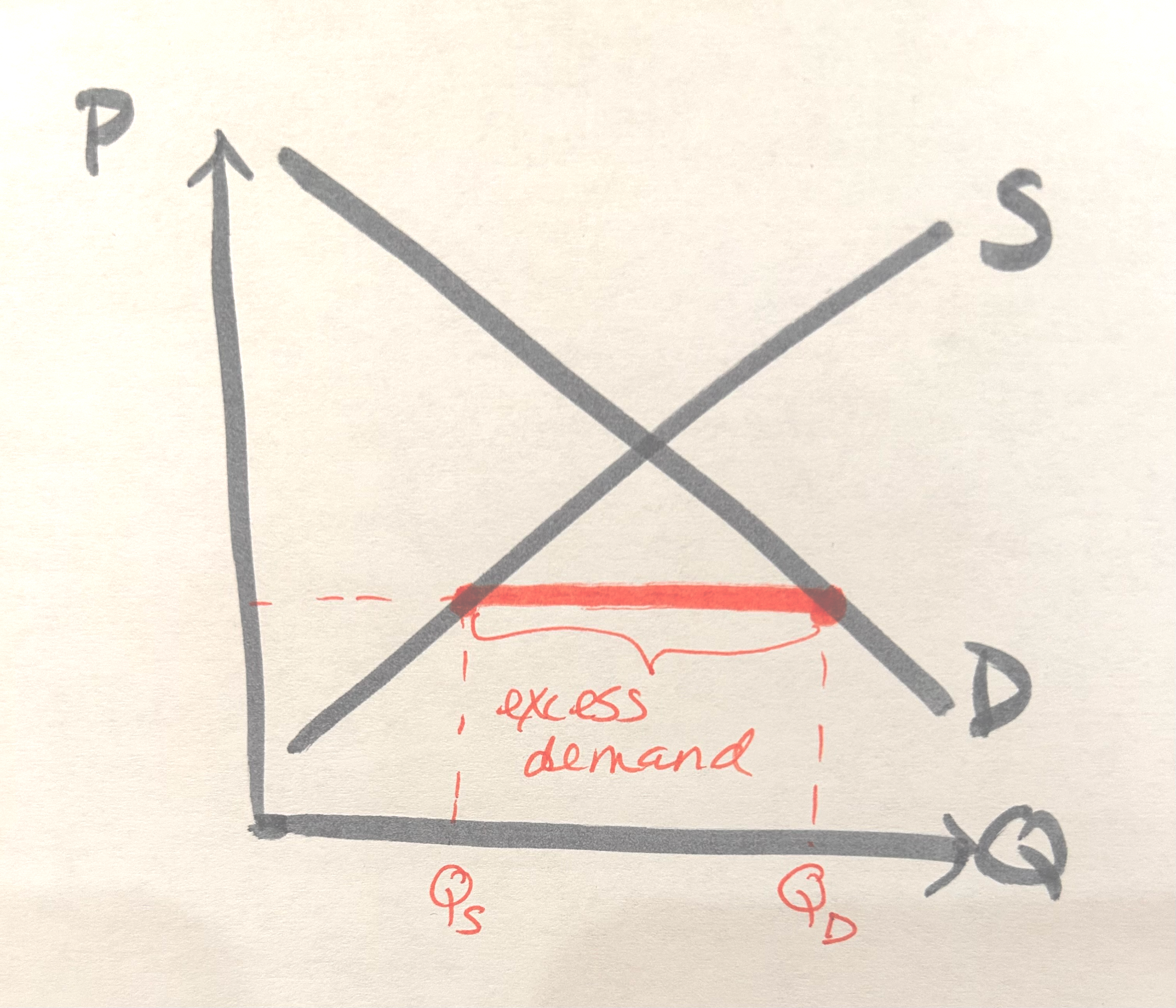
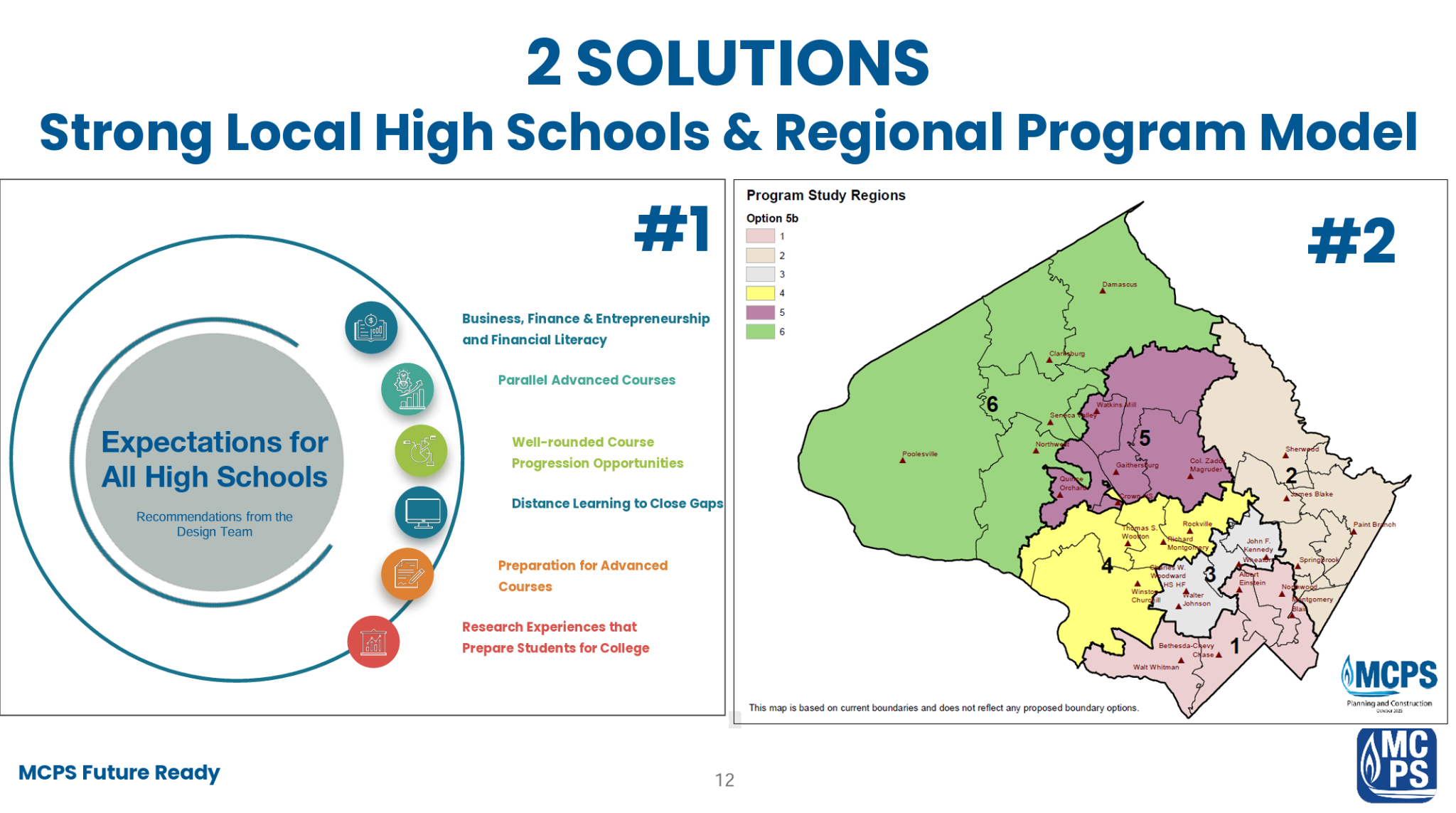
The supply side of this shortage comes from the limited availability of slots in some programs that are geographically accessible to all students. The demand side has two components: (1) students who genuinely want those particular specialized programs and (2) students whose interest is not so much in a special program but instead in leaving home schools they dislike, so much so that they’re willing to endure long commutes and leave middle school friends. When MCPS leadership presented to the Board of Education in November (slide below), they framed their approach as two-pronged: strengthening all high schools (reducing the first component of demand), and creating the regional program model (creating more supply to meet the second component of demand).
What is the proposed regional programs solution?
Divide MCPS into six “regions” above. Each region will offer multiple program pathways across five program themes at some high school in the region.
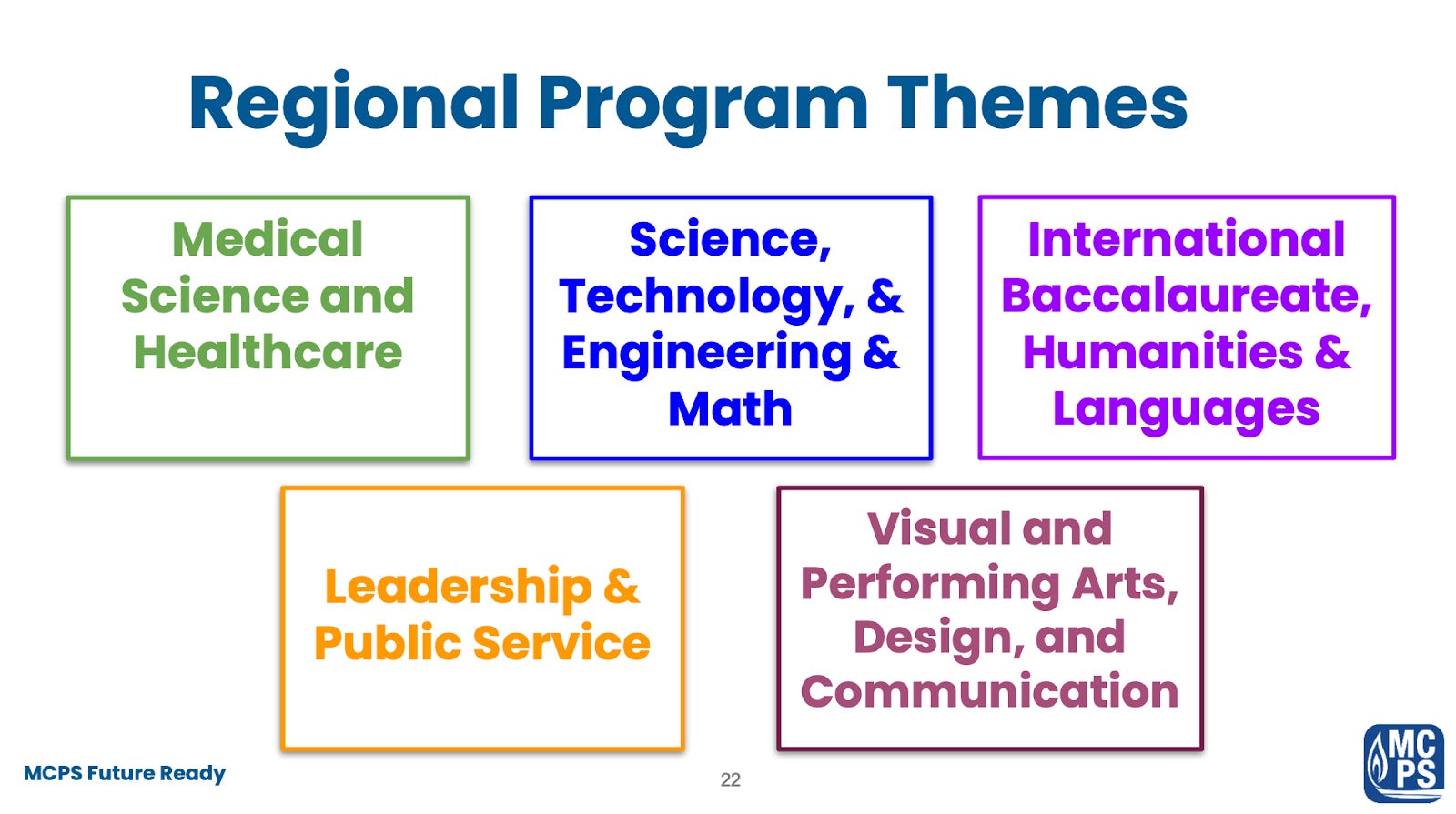
Students can’t cross regional lines, so there will be no more countywide programs; the boundaries governing existing regional choice programs will no longer apply. Some (criterion-based, in MCPS-speak) but not all programs will select based on student performance, while others (interest-based) will assign oversubscribed slots via lottery. Schools will reserve some program slots for their own geographically-zoned students and some for students from the rest of their region. The current conversation is more about which programs will be where and who gets to attend them, than what makes a program a program or what makes a region a region.
What are the costs and benefits of the proposal?
This is straight out of an econ textbook–considering the benefits, net of costs, of multiple options before choosing one–so I have a soft spot for it, even though that isn’t how decision-making in MCPS or most districts works. Cost-benefit analysis doesn’t make sense as a planning tool in isolation: logistics, like the simultaneous timing of high school boundary studies that have to happen now because building capacity is changing, and politics, like longstanding resentment about historical inequities, matter. But it’s a useful tool for generating questions.
The cost-benefit logic is simple: we have limited resources, so we need to make the most of them. What follows is quicker (there’s no discussion of alternative options, so we just have the regional programs model to consider) and dirtier (since the model is not fleshed out) than a full-blown cost-benefit analysis.
In October, MCPS provided a sample model budget for region 4.
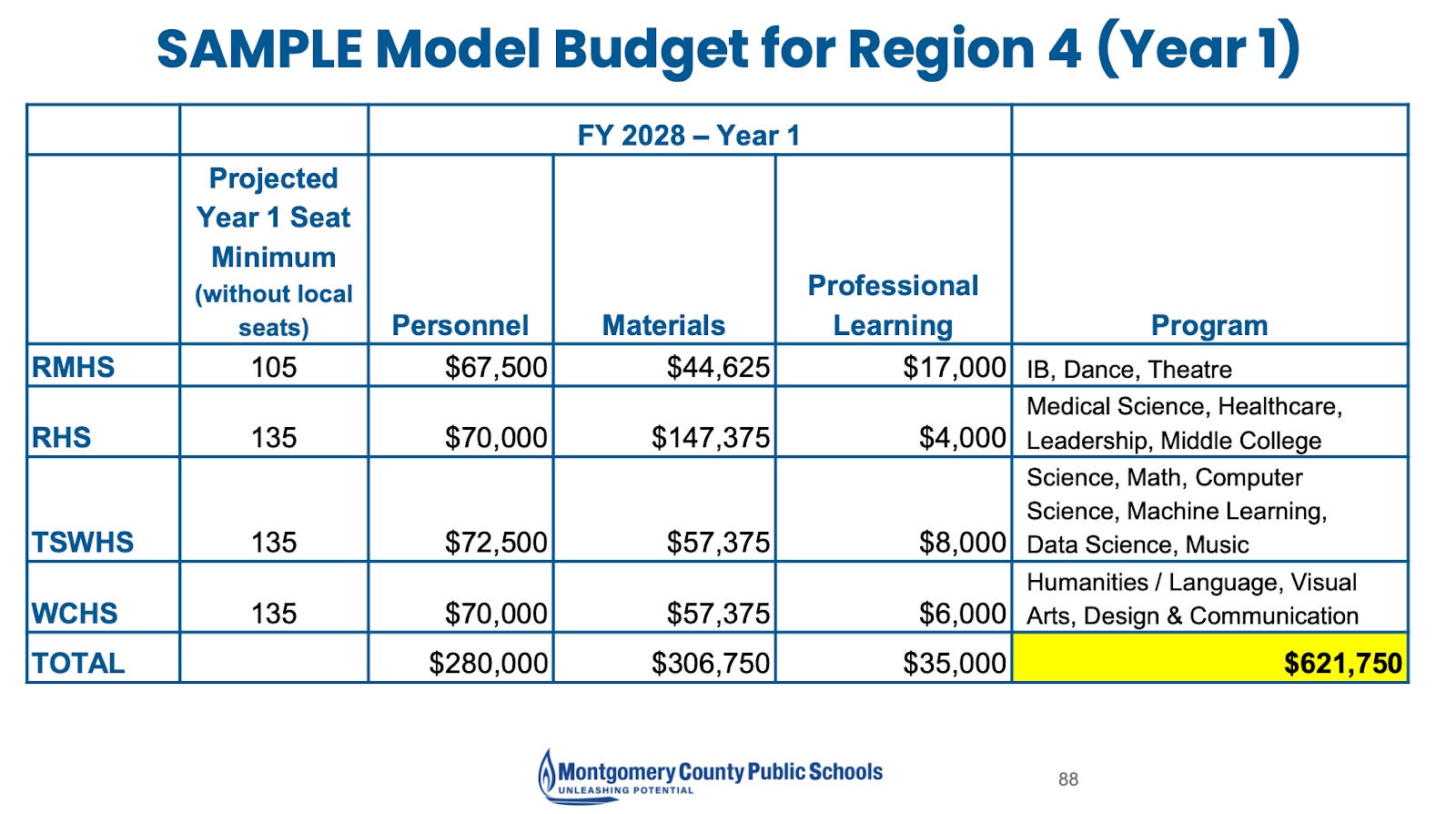
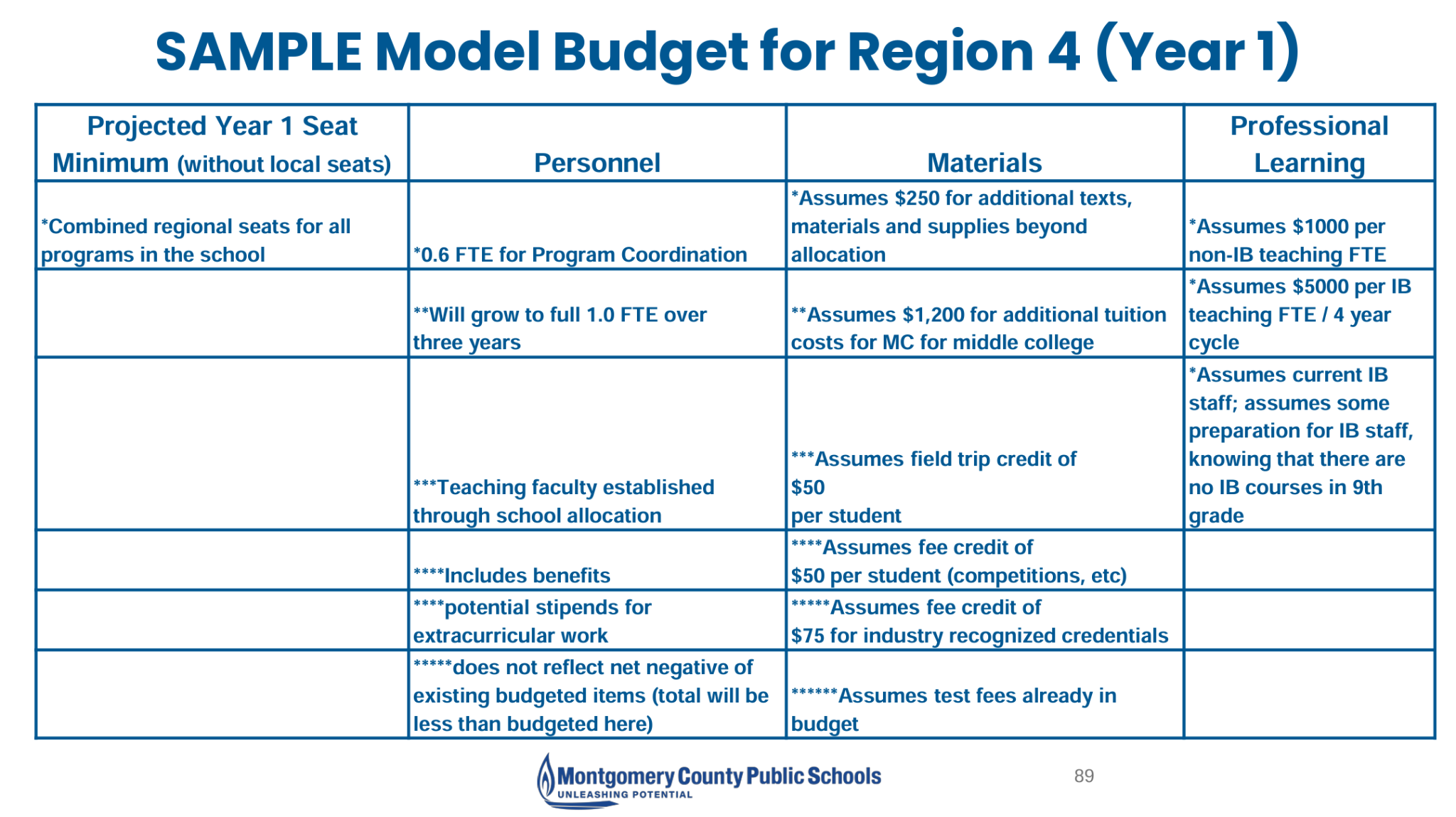
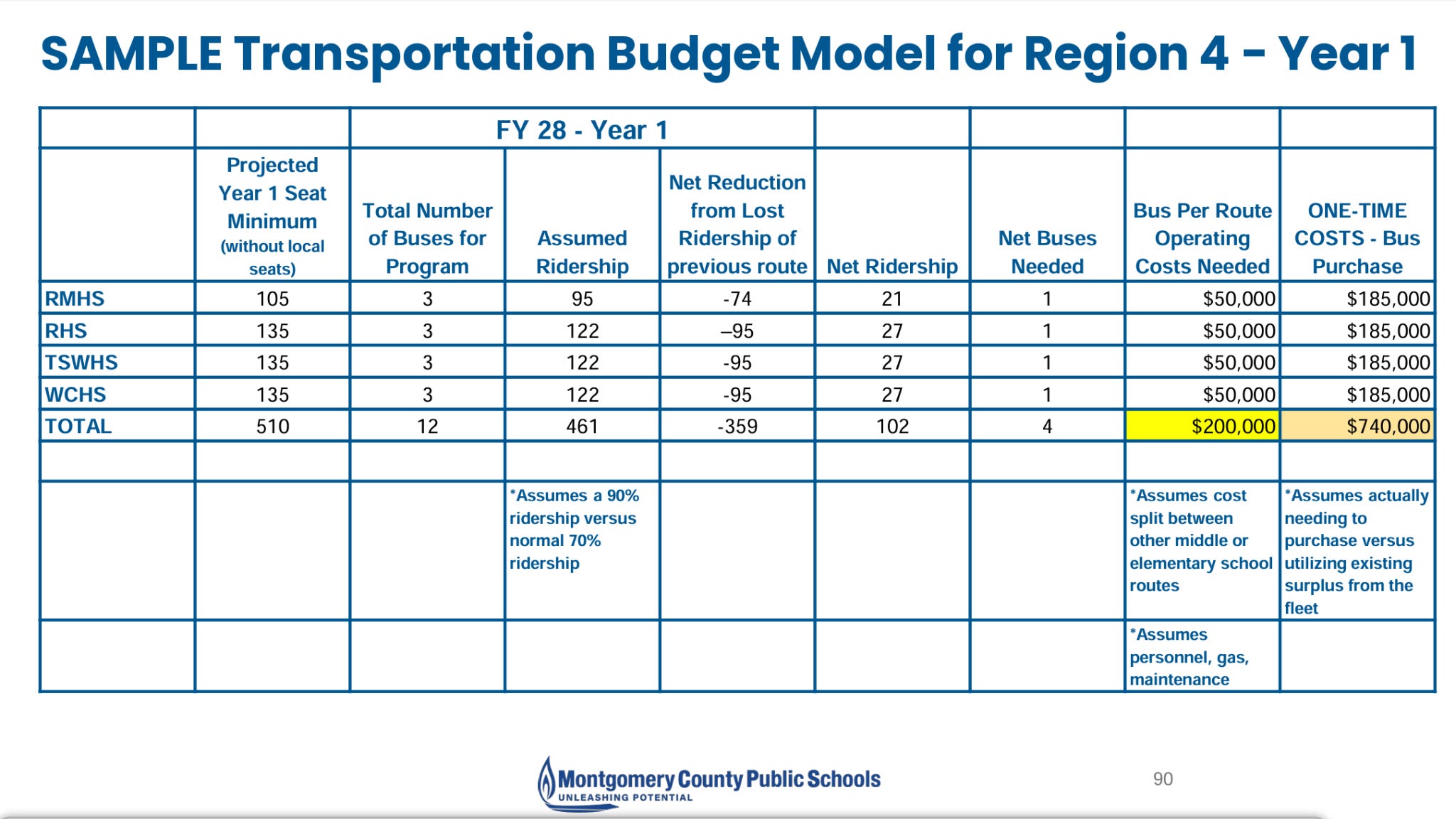
Disregarding the one-time cost of new buses, the annual costs for year one (when the program first enrolls students and is still phasing in) in region 4 are $821,725. Assuming this is typical and there are six regions, the annual cost in year one would be nearly $5 million. That sounds like a lot, but let’s put it into context. Dr. Taylor’s new total operating budget request for FY2027, which has yet to be approved by the Board of Education and County Council, is for $3.8 billion, which would make $5 million just one-tenth of one percent of the operating budget. Using projected FY2027 K-12 enrollment (see Table 4 of the budget request) of 155,550, this comes out to about $32 per K-12 student for year one. (The FY2027 request also includes $922,815 for planning next year, before any students enroll.)
The $32 per student estimate captures what economists call the accounting costs associated with the new model. The estimated accounting costs may be incomplete: for example, it may take more than 60% of one staff member’s time at each high school to coordinate the programs in year one. Given budgetary forecasts, accounting costs will get a lot of airtime in upcoming operating budget discussions.
But even if the accounting cost estimates fully captured all resources devoted to the programs, there’s another important set of costs to consider. Opportunity costs describe what we give up when we devote resources to one use. What is the next-best thing MCPS would be doing–not just with the budgeted amounts going forward, but with the substantial amount of time planning and engaging with the community now–if it were not pursuing regional programs? Would it have related to its solution #1 above, strengthening all high schools? How would its benefits compare to those of the regional programs?
Opportunity costs are harder to think about concretely than accounting costs because we don’t know what would have happened otherwise–in this case, if MCPS had not pursued the regional programs. Accounting costs generate talk because they are specific and included in the budget, a public document. But any analytic discussion of the regional programs, or anything else, should openly address opportunity costs–this happens all too rarely.
How did we get to this particular solution?
This seems a good time to mention that I’m not an MCPS “insider” and insiders are not leaking to me (yet!). So my best guess based on public reporting is it’s because Dr. Taylor is a fan of this approach (he implemented a regional programs model in his previous district, Stafford County Public Schools, Virginia), he saw dissatisfaction with the excess demand for some MCPS programs, and he saw a fit.
Now or later?
This is a big issue. MCPS leadership is expressing urgency around implementing the model, using AI to generate the creepy image below for the Board to represent the 2,000 students they say are now on program waitlists.

The PTA and the teachers’ union are pushing MCPS to slow down the roll out until they nail down more details. MCPS asserts the process is not rushed and shared their timeline. Just because a timeline exists doesn’t mean it is feasible or complete; just because an advocacy group says things aren’t ready doesn’t mean that’s true either.
This is a common political dynamic: individual actors release their statements, but the public doesn’t know whom to trust. I’d love to hear leaders from MCPS, the PTA, and the MCEA going back and forth in unscripted, substantive conversation, in real time and on the record.
Questions for MCPS
What exactly makes a program a program (as opposed to, say, a couple of pre-existing electives, which would lower the opportunity costs but presumably add less value for students)?
What determines which programs are placed in which regions and schools? (Be specific, and not just about how many meetings were held or how many people filled out a survey.)
Does MCPS view the quality of the programs, which could be measured in various forms of inputs (e.g., course offerings, teacher training) and outputs (e.g., future job placement and earnings, test scores, attendance, high school graduation), as central to understanding if the model succeeds? How much of success is about opportunities to access these programs, independent of quality? And what if there’s still a lot of excess demand for standout programs that convert from countywide to regional?
What will MCPS do to ensure success across all regional programs, given the record of variable success in existing programs? Which individuals–in school buildings and in the central office–will be responsible for implementing which aspects of the plan? What will accountability look like?
How will MCPS assess the success of the model? Will they gather and describe data, including qualitative data on what actually happens in the programs, and describe it in real time, so it can help improve the programs as they develop? Will these descriptive analyses be available to the public?
What is the planning and implementation timeline, not just for the central office, but for schools? How many hours are estimated for different tasks, and what is the basis for these estimates?
Pop quiz
Which of the following is a potential opportunity cost of starting the regional programs model?
a. Tutoring for some middle school students who are not proficient in math.
b. Everything in the strategic plan.
c. Dr. Taylor’s sleep.
d. All of the above.
e. None of the above.
f. I need more details to answer your trick question.
Answer key
d. All of the above are correct. The opportunity cost of something is what you forgo in order to do it. More details:
a. Really, anything MCPS might plausibly do with the money is an opportunity cost. Since the majority of middle school students in MCPS–and Maryland–aren’t proficient in math, and the types of tutoring programs that are most effective are relatively expensive, let me emphasize: tutoring some (small subset) of them is a potential opportunity cost of the regional programs.
b. The strategic plan has broad ambitious goals and could be supported with seemingly infinitely many activities and costs. So yes, some relative activities might be crowded out to try to keep the overall budget under control.
c. Time is the ultimate scarce resource–even the retiree benefit trust can’t provide more hours in a day. Dr. Taylor is prioritizing this initiative, and those hours potentially come from his sleep, his time with family, exercise, hobbies, and, of course, other things he and his team could be doing for MCPS.
Extra credit
Sunil Dasgupta interviews Byron Johns, co-founder of the Black and Brown Coalition, about regional programs on the I Hate Politics Podcast. This was a fascinating conversation that got into why Johns wants MCPS to do something now even if the plan is not fleshed out, why Dasgupta cares about the details, and eventually led to the two finding some common ground in their concerns about the lack of accountability in MCPS. When you don’t like the status quo, how do you decide when it’s worth rolling the dice?
Evelyn Chung cautions the district against chasing “shiny new programs while neglecting the foundation.” How do our systems provide incentives for leaders to chase the new vs. to strengthen foundations? And what would it take to change those incentives?
Next up
Who does what in public education? (MCPS version)
I’ll be posting every other Wednesday.
Exit ticket
Share your frequent, low-stakes feedback with me. I always welcome your (anonymous or attributed) extra credit responses, along with story ideas, questions, suggestions, and corrections. And if you enjoyed this post, I’d be grateful if you share it.